
Most people who learn vibe coding never make a dollar from it.
They build demo after demo. Portfolio projects. Todo apps. Clones of things that already exist. Then they wonder why nobody's paying them.
The problem isn't justa skill issue.
It's thinking that you can't make money from vibe coding...
And not having an aim and a process to get there.
If you'd pick one article to master on vibe coding, let it be this one. As it will bring a freedom unlike anything you experienced to your life, if you practically complete the steps to use it as a wealth creation engine.Save this article to practically apply it, and come back to it again and again as you want to grow your income. I can guarantee you if you do this, your future self will thank you for it...
Ready to get started?
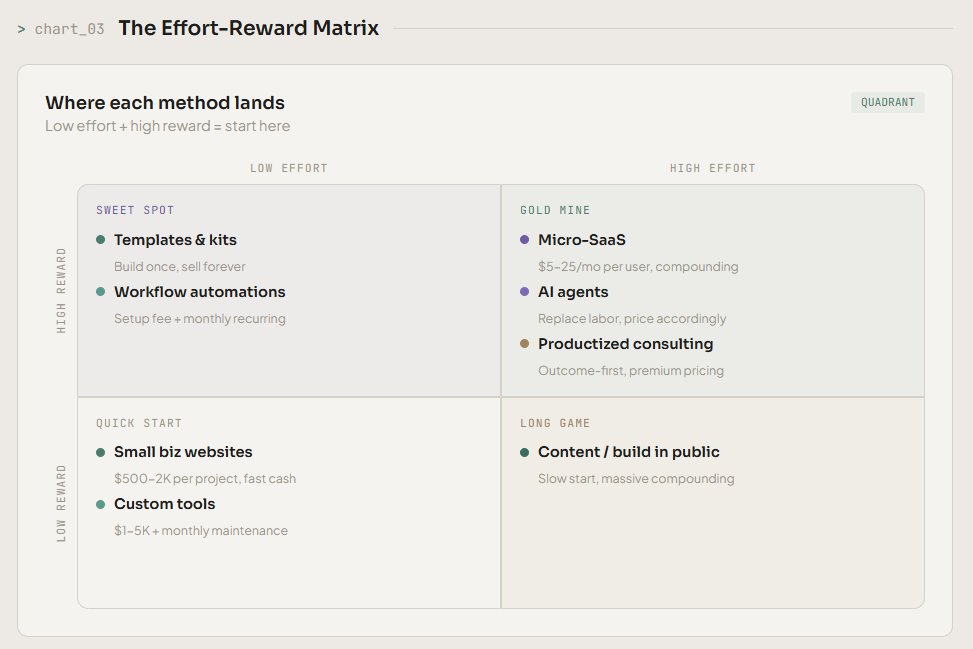
1. Small Business Websites
Difficulty: SUPER EASY
This is the single lowest-friction entry point.
Every small business needs a web presence. But most of them either don't have a website or have one that's super crappy.
You can easily build a few websites like this in a day, and it will cost you a few dollars in tokens to acquire each customer and build a website for them. Depending on the nation/city you are targeting, you can make more for your time...
Practical guide for acquiring customers:
1. set up a crawler like Firecrawl for your OpenClaw or your terminal
2. fetch emails and social media contacts of small businesses
3. sign up for an email service for bulk emails
4. talk to your agent for automating social media cold dms
5. then start serving the interested parties and start making an income
Pro Tip:AI can organize and automate all these. You can also create agents to help you with each part, and run everything as if you had a team of agents, each skilled at their job, because in the age of AI, you can.
There are millions of small businesses that need this service.Because most of them avoided getting a website because it was expensive before. Now you can solve their problem for a fraction of the cost.
2. Custom Tools for Small Businesses
Difficulty: EASY
Small businesses need simple software but can't afford $10K+ dev shops. Appointment systems. Inventory trackers. Lead capture forms. Basic dashboards for their custom needs.
You can build these in a day or two and charge more than regular websites, plus charge recurring maintenance fees of $50 to $100/month, on top of the initial service cost.
Practical guide for building what small businesses really need:
1. follow the same process explained in the section above for acquiring customers
2. prepare a form for customers to fill exactly their needs
3. make sure that you understand their needs and fully confirm their user journey and exact outcomes they wanna achieve
4. build the tool with an AI coding assistant. Most of these take a day, maybe two. Don't overcomplicate it.
5. deploy it, walk them through it, and set up a monthly maintenance agreement for updates and support
Pro Tip: you can also do this niche based.Walk into a hair salon, a gym, a restaurant. Ask what they hate doing manually. Build something that solves the problems of many businesses in the same niche.
If they're already using something but it's not good enough or easy enough for them, that's also great intel.
3. Templates, Starter Kits, and Prompt Packs
Difficulty: EASY
This is the build-once, sell-repeatedly section.
If you've figured out a stack that works well with AI tools, package it.
SaaS boilerplates with auth and billing ready to go. Notion templates for specific workflows. Figma kits. Prompt libraries that actually produce consistent output. Frameworks that you are really creating immense value for a specific task.
These are digital assets with near-zero marginal cost.
Sell them on Gumroad, Lemon Squeezy, or your own site via having a Stripe.
The best ones solve a very specific starting-point problem, so the buyer skips 2 days of setup.
Practical guide for creating and selling digital products:
- pick something you've already built that saved you time and made results in something noticeably better
- clean it up and package it
- set up a Gumroad or Lemon Squeezy store, or have a Stripe site
- create a simple landing page showing the before/after of using them. Show the time saved, results produced, benefits your target persona will get.
- post it in tartget communities where your buyers hang out. Subreddits, Discord servers, X. Let the first 10 buyers tell you what to improve. Then iterate and improve while building a user base
Pro Tip: the best digital products come from your own frustrations. If you build things that come from your biggest painpoints, you'll likely solve a big problem for many other people.Package your problem and solution.
4. Paid Workflow Automations
Difficulty: MEDIUM
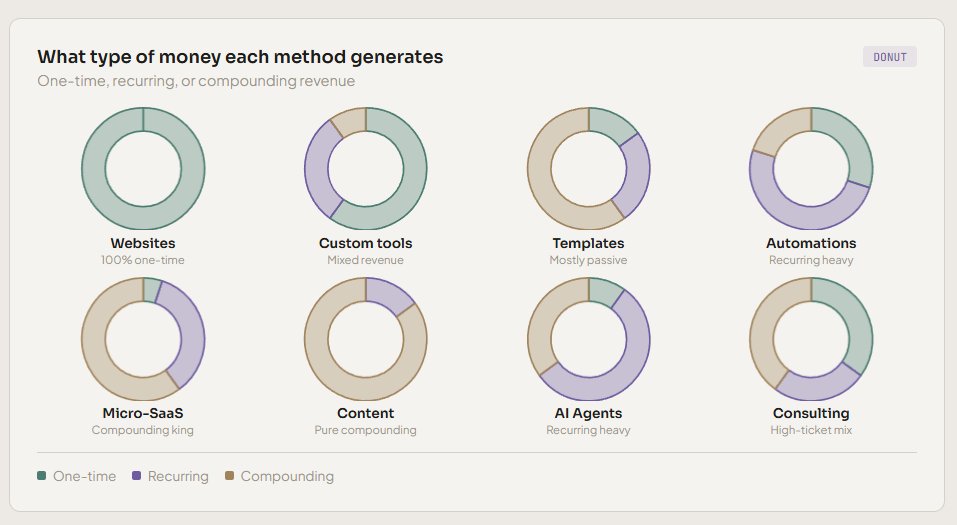
Solve problems inside the tools people already use. Connect apps via Zapier, Make, or n8n. Add a lightweight dashboard or script on top. Charge a setup fee plus monthly maintenance.
B2B "annoyance work" is a goldmine. Cleaning spreadsheets. Generating weekly reports. Formatting documents. Wrangling CSVs. Nudging follow-ups. Compiling leads. This work is tied to revenue and operations, so buyers move fast and churn is low.
You're not selling automation. You're selling hours back.
Practical guide for landing your first automation client:
- go on X, Reddit, or LinkedIn and search for people complaining about repetitive manual work. "I spend 3 hours every week on..." is your goldmine phrase.
- DM 5-10 of them and ask what their workflow looks like. Don't pitch yet. Just listen and understand the pain.
- pick the simplest one and build a demo using n8n or fully vibe code it. Record a 2-minute video showing it working with their actual use case.
- send the video back to them. Say "I built this for you, here's what it does." Iterate until that's a perfect automation for that use case.
- charge a one-time setup fee and a monthly maintenance fee. The monthly maintenance fee will help compound your income.
Pro Tip: once you've built one automation for one client, you can usually sell the same system to 5-10 other businesses with similar workflows. Build once, sell many times with little customization needed after.
5. Micro-SaaS: One Job, One Screen, One Outcome
Difficulty: MEDIUM
This is the gold mine. Find a very specific problem.
> Invoice generator for dog walkers. > Content and script creator for TikTok creators > Client prep checklist for freelance workers
There are thousands of SaaS businesses that can be created with AI in a few days.
Build a tiny, focused tool around it. Charge $5 to $25/month. Or charge a larger lifetime fee.
Traditional dev teams can't justify building something this niche. That's exactly why you can own the entire market.
Vibe coding cuts months of development down to days, and you can test many ideas and see which ones are connected with your passions, where you can deliver an excellent service.
There is a new breed of vibepreneuers now who have compounding income coming from multiple SaaS businesses they vibe-coded.
One of the most famous ones to follow is @levelsio, you can follow him to get inspired, and see that it is really possible to achieve this.
Practical guide for launching your first micro-SaaS:
- pick a niche you actually understand. If you're a freelancer, build for freelancers. If you know restaurants, build for restaurants. Your own frustrations are usually the best starting point.
- build a super simple landing page that describes the MVP (minimum viable product) of your tool and has a "Join Waitlist" button.
- share it in 3-5 communities where your target users hang out. If nobody signs up in a week, the idea isn't strong enough. Try a different pain point.
- if people sign up, continue to iterate with feedback. Don't add too many features until someone asks for them.
- set up Stripe for payments ($5-$25/month), ship it to your waitlist, and ask for feedback immediately.
Pro Tip: focus on a very focused MVP and landing page first; only continue if PMF (product-market-fit) validation is present. And then iterate based on what users want after gathering initial interest. Follow this process like a system, and you will have a great process for MVP -> PMF -> Iteration.
6. Content: Build in Public
Difficulty: MEDIUM
Millions of people are trying to learn vibe coding right now. If you're building stuff, just document the process. X content, videos and articles, YouTube tutorials, blog posts, live coding streams, you name it.
The content creates an audience. The audience creates distribution.
The distribution creates monetization through sponsorships, payments from social media platforms, as well as prepares your channels for building products with bigger user bases.
Every tool you build becomes a case study, every learning becomes something you can be of value to others, and every case study becomes content. It's a great flywheel to compound everything you are doing.
The space is still early enough that authentic practitioners stand out from generic "AI guru" content.
Practical guide for building an audience that compounds:
- next time you build something with AI, think in terms of what has been helpful, what you can turn into content
- structure your learnings and new tools you mastered into X content, and YouTube videos.
- Make sure you are really sharing useful content that you'd want to bookmark yourself.
- do this consistently for 30 days. The algorithm rewards consistency more than perfection. Make sure not to hoard valuable information. Let it help others greatly.
- once you start to hit a certain audience number, start reaching out to AI tool companies too directly for sponsorships. Just make sure they are stuff you'd normally use, so you don't sell snake oil.
Pro Tip: you don't need to be a master at something to create content. But you should be going for mastery as much as you can, and stay consistent, and analyze trends daily. Just don't do it like a gimmick;become someone who can share valuable information...
7. AI Agents That Replace Labor
Difficulty: MEDIUM
We've moved past chatbots into autonomous agents. Build an agent that does one thing exceptionally well.
> real estate agent that qualifies leads from listings and books appointments. > support agent that handles refund requests for Shopify stores. > research agent that compiles competitive intel weekly.
Sell the labor the agent replaces. Price accordingly.
If it replaces a high-value employee greatly, it will be worth a lot.
Here, I'm not talking about just creating a mere skill MD file, but something like a full package, with its own tools, processes, and results that will even shock you when you use it.
Practical guide for building and selling your first agent:
- pick one repetitive task that a business currently pays a human to do. Not something creative. Something boring and predictable. Data entry, lead qualification, appointment scheduling, report generation.
- build the agent using Minimax, GLM, Claude, or OpenAI's API. Start with one single workflow. Don't try to make it do everything. One job, done well, is worth more than ten jobs done badly.
- test it yourself with real data for at least a week. You need to know every edge case before you put it in front of a paying client.
- find 3 businesses that currently have someone doing this task manually. Offer a free 2-week trial. Let the results do the selling. Iterate with their feedback.
- price it as a fraction of the salary it replaces. If the human costs $4K/month, charge $500/month. The ROI is obvious, and the client says yes fast.
Pro Tip:make sure that this agent becomes something that can really replace the workflow of a real job in a spectacular way, that's how you'll know you hit the jackpot.
8. Productized Consulting (Outcome-First Selling)
Difficulty: HARD
Instead of building something and then looking for clients, sell the outcome first. Pitch a clear business result:
> reduce support workload > improve lead qualification > speed up audience growth > build a reliable content pipeline
a fixed deliverable. something a business wants. solutions you can provide via consulting.
Everything you learned on automation, vibe coding, and other skills you have learned is an advantage here to really help businesses with consulting services.
Practical guide for landing your first consulting gigs:
- pick one specific outcome you can deliver. Outcomes sell easier, vague promises or "I can do everything doesn't work as well"
- build one deck and show examples of businesses who have achieved a better outcome using AI in that target problem/solution.
- write a short proposal template: the problem, the deliverable, the timeline (usually 1-2 weeks), and the fixed price. Keep it short and to the point.
- start from warm intros for the first couple of customers if you can, while utilizing the outreach strategy in the beginning of this article for cold reaches (check section 1)
- deliver fast, deliver clean, and ask for a testimonial. Every testimonial makes the next sale easier. After 3-4 clients, momentum will compound.
Pro Tip: the secret weapon here is speed. When a client expects a 4-week delivery and you show up with a working prototype in 3 days, their trust in you skyrockets. Underpromise on timeline, overdeliver on speed and results. Then same customers may want to get your services for other parts of their business as well.
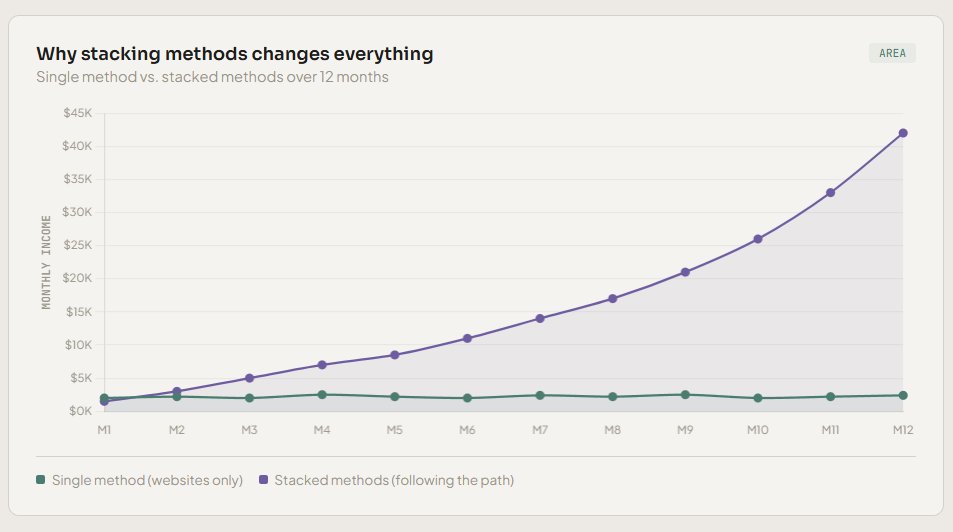
I can guarantee that if you apply this guide:
> leaning onto what you are passionate about among these > following these strategies till the end, and stick to it with repetition > and don't quit halfway during the parts you don't believe yourself yet
Then you will bring so much new compounding income and freedom into your life.
Don't ask anyone for permission, even if you don't believe you can do all this, start and just do the steps.
I built an incubator business that achieved $350M valuation in 9 months, starting from $5k, with no investors backing me. The things I shared here are not coming from someone who just prompted an article.
Utilize them. Change your life. Also, save this post so you can come back to it again and again as you try new things. These 8 areas will create many millionaires and billionaires. No reason one of them shouldn't be you.
There are no limits. Good luck!