
Most advice around vibe coding tells beginners one thing: build fast. But when you look at real developer discussions, tool traces, and debugging sessions, a different pattern appears. The builders who actually progress don’t just move fast. They move fast and verify constantly.
Without that second part, the same failure mode appears everywhere:
- code that looks plausible
- weak verification
- repeated local minima
Beginners reach the “it works on my machine” moment — and then stall.
This guide breaks that loop.
It gives you a beginner-safe build cycle you can run every session, so your speed compounds instead of quietly breaking things.
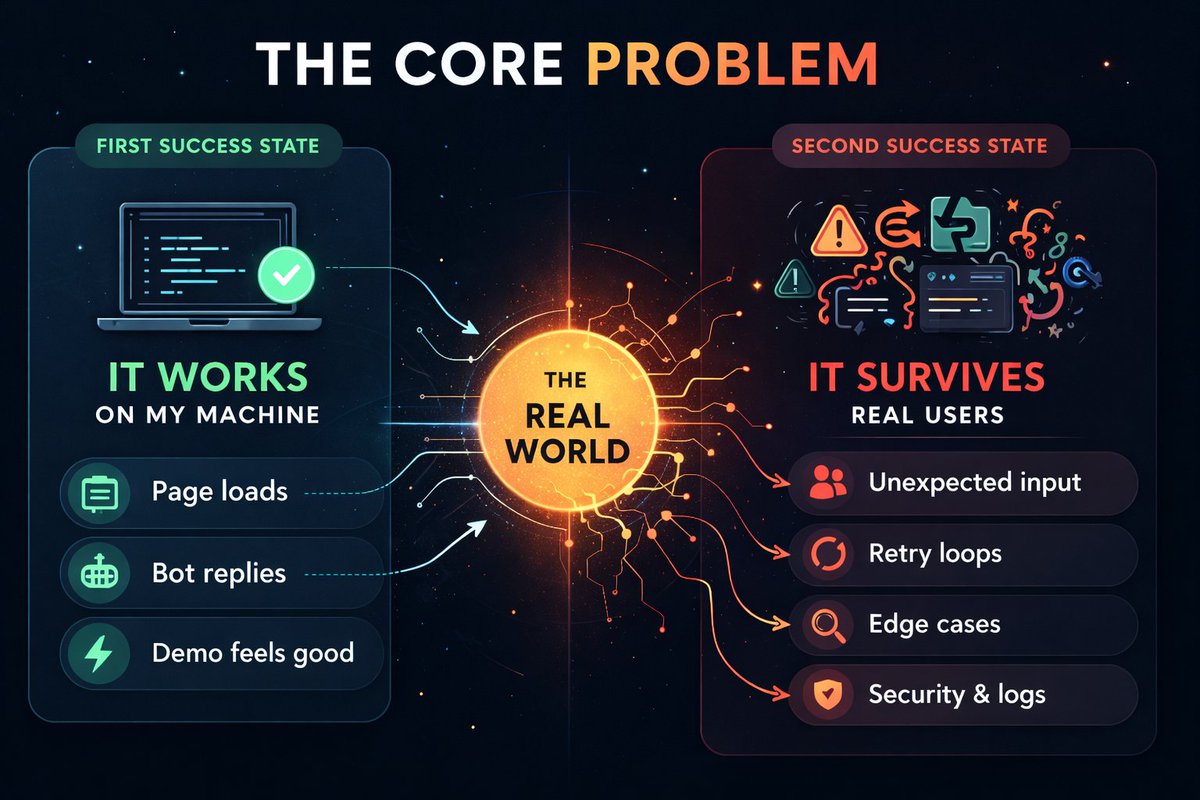
The Core Problem
Most beginners optimize for the first success state:
“The page loads.” “The bot replies.”
That feels like progress.
But real failures appear in the second state:
- unexpected user input
- retries and race conditions
- bad data
- edge cases
- accidental secrets in logs
Vibe coding increases output speed, which is good.
But it also increases error throughput if you don’t add structure.
So the real beginner skill is not:
write perfect code.
It is:
closing the loop between generation and verification.
What Changed
Three shifts in the tooling layer created this environment.
1. AI assistants now generate multi-step code, not just autocomplete. Tools like Copilot and Cursor increasingly generate entire edits, files, or refactors.
2. Deployment has become trivial. Platforms like Railway and similar services let beginners ship projects to real users quickly.
3. Reliability did not become automatic. Security risks, edge cases, and production constraints still exist.
So the competitive advantage is no longer:
“Can I produce code quickly?”
It is:
“Can I run a reliable build-check-fix loop every day?”
The 5-Loop Build System for Beginners

1) Scope Loop — one promise per session
Before prompting, define one user-visible outcome.
Examples:
- “User can sign up with email and confirm account.”
- “The user can create one note and see it after refresh.”
If your prompt asks for five systems at once, youcannot debug the cause of failure.
One feature → one loop.
Prompt for structure, not just output code.
Use prompts that force explicit interfaces, validation, and tests.
Example skeleton:
This turns AI output into inspectable code, not mystery output.
Every generated change must pass a quick verification loop.
Minimal checklist:
Run checks before trusting the output.
Beginners often skip this and pay later.
Keep every change in small commits with clear messages.
If something breaks:
- revert one commit
- continue working
Small reversible steps beat heroic late-night rewrites.
Before shipping, run a quick risk pass.
Ask the model to check for things like:
- auth bypass risks
- unsafe eval or exec usage
- missing rate limits
- unsafe user input rendering
Then, verify manually against something like OWASP Top 10.
AI can assist with security — but it should never be the only check.
Discussions around vibe coding on X frequently emphasize:
- build quickly
- verify outputs
- iterate with structure
—not just prompt better.
Documentation for modern coding assistants also emphasizes iterative workflows, edits, and review loops rather than one-shot perfection.
Testing and debugging practices remain essential, regardless of AI speed.
Directional inference: Beginners who adopt a consistent build-check-fix loop should reduce avoidable breakages compared to ad-hoc prompting.
The exact impact depends on project type and measurement setup.
Prompting for:
- full app
- auth
- billing
- analytics
— all in one generation.
Other common traps:
- accepting code without running tests
- keeping one giant “final” commit
- mixing secrets into prompts or repo history
- assuming “AI answered” means “system is correct”
Speed without structure multiplies these mistakes.
A 7-Day Beginner Plan
Day 1: Choose one tiny app with one clear user flow.
Days 2-6:
Each day:
- build one feature slice
- run the contract prompt
- add one test
- commit safely
Day 7:
Run a full safety pass and write a short runbook describing how the app works.
By the end, you will have:
- working code
- tests
- a repeatable workflow
Not just a demo.
This workflow can also be expressed as a repeatable system.
Objective
Turn beginner vibe coding into a structured shipping workflow.
Inputs
- feature goal
- existing codebase
- tests
- runtime logs
- risk checklist
Process
- Define a scoped feature outcome
- Generate constrained implementation
- Run tests and failure-path checks
- Patch issues and repeat checks
- Commit and record remaining risks
Outputs
- working feature slice
- passing tests
- risk notes
- reversible commit history
Guardrails
- no deploy with failing tests
- no unresolved high-severity risks
- no secret exposure in repo artifacts
Vibe coding is not fake coding. It is compressed software iteration.
If you pair that speed with verification loops, you compound skill.
If you skip the loops, you compound bugs.
The real upgrade isn’t better prompts.
It’s building a system that makes every session safer than the last.
I started a private Telegram channel where I’ll be sharing insights and updates regularly: https://t.me/+GJ-FEpzcZrtmMTky
If you could fix one bottleneck in your build-verify loop this week, which one would it be?