I don't schedule tweets. I don't use a social media manager. I don't batch content on Sundays.
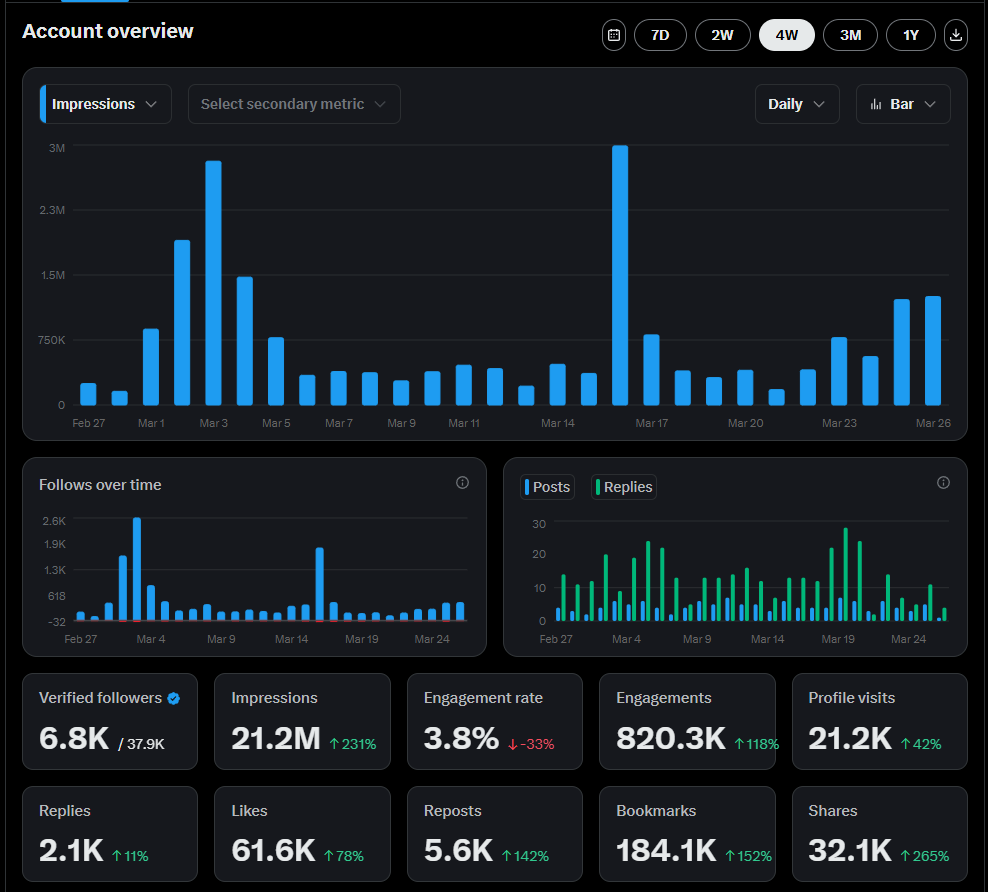
I have an AI agent named Claire that runs on OpenClaw. She lives on my Mac mini, monitors my Discord, and handles the entire content engine that's generating 20 million views per month on X.
Here's every piece of the system, broken down so you can build your own.
PS: This entire system is built on one foundation: a Brand Voice skill for your agent. With it, every tweet, article, and email sounds like you.
I'm giving away the exact skill template I use. Drop it in, your agent interviews you for 5 minutes, done. Grab it free here:https://corey-ganim.kit.com/a65257ea2c
The Architecture: One Agent, Multiple Skills
OpenClaw is an open-source AI agent platform. Think of it as the operating system for your AI assistant. Claire runs 24/7 on my machine, connected to Discord, Gmail, Google Calendar, and my file system.
The real power comes from skills. Skills are markdown instruction files that teach the agent exactly how to do a specific task. Not vague prompts. Detailed, step-by-step workflows with formatting rules, voice guidelines, and quality checks.
Here are the skills that power my X content:
- x-article-creation - end-to-end X article writer (body, intro, headlines, thumbnails)
- youtube-video-promotion - turns podcast transcripts into tactical promo tweets
- tweet-cta - generates CTAs that drive waitlist/community signups
- last30days - researches any topic across Reddit, X, and the web from the past 30 days
- brand-voice - my full voice profile so every piece of content sounds like me
Each skill is a file. I drop it into Claire's workspace and she knows how to use it. No coding or messing around with APIs. Just simple markdown files.
The Quote Tweet Machine
Quote tweets are the highest-leverage content format on X right now. Here's why: you're borrowing someone else's audience AND adding original value on top.
My process:
I scroll X for 5-10 minutes and find tweets that are getting traction in the AI/business space. Could be a viral thread, a tool announcement, a hot take. I copy the URL and send it to Claire in Discord:
"Draft a tactical quote tweet breaking down how someone could turn this into a business."
Or: "Draft a quote tweet with our take on this."
Claire reads the original tweet (she has browser access), pulls the key insight, and drafts a response that adds a layer of tactical value. Not just "great tweet." Not just a reaction. A numbered breakdown, a contrarian take, or a step-by-step playbook.
The format that's working best right now:
One quote tweet I posted recently broke down how to turn a Kevin O'Leary clip about customer acquisition into a $250-500K/yr AI business. It hit 471K views and 7,600 bookmarks.
The key: make the quote tweet valuable on its own. If someone never clicks the original, they should still learn something.
Quote Tweets + Short Video (The Emerging Format)
The next evolution is attaching a short video to your quote tweet. This is starting to outperform text-only quote tweets because the video autoplays in the feed and stops the scroll.
The formula:
- Find a viral tweet in your niche
- Find a 10-30 second meme video that viewers will recognize
- Quote the tweet with the video attached
- Keep the text short (1-3 sentences max since the video does the heavy lifting)
This works because you're combining two attention signals: the social proof of the original tweet's engagement plus video autoplay. X's algorithm favors video content, and when you layer that on top of an already-viral tweet, the distribution compounds.
I'm leaning into this format more and expect it to become the dominant play in Q2 2026.
The X Article Workflow
X articles are long-form posts that live natively on X (you're reading one right now). They get distributed in the feed like regular tweets but can be 700-1000+ words.
My skill handles the entire workflow in one shot:
Step 1: Topic. I either give Claire a specific topic or she researches what's trending using the last30days skill, which pulls real conversations from Reddit, X, and the web.
Step 2: Article body. 700-1000 words, tactical format. Numbered list of 5-10 items, each with a title, explanation, and specific details. Every section should be something the reader can implement.
Step 3: Intro + CTA. A hook that creates a curiosity gap, 1-2 sentences of context, and a call-to-action linking to a lead magnet.
Step 4: Headlines. Claire generates 7 headline options using proven patterns. Numbers, parenthetical hooks, curiosity gaps, specific time/money claims. I pick the one that feels right.
Step 5: Thumbnails. She builds 3 different thumbnail designs as HTML files, renders them with headless Chrome at exactly 1250x500 (the required 5:2 ratio for X articles), and delivers the PNGs.
The whole thing, from topic to publishable article with thumbnails, takes about 10 minutes of my active time. Most of that is reviewing and picking headlines.
YouTube to X Pipeline
Every podcast episode becomes X content. After I record with a guest, I send Claire the transcript and she extracts the single most tactical insight and writes a promo tweet.
The format:
The rule: lead with the tactic, not the video announcement. "New episode dropped!" gets ignored. "Most small businesses pay $5-10K/month for a marketing agency. We replaced the entire stack in one session with Claude Code" gets bookmarked.
This skill alone has driven thousands of views to episodes that would have gotten a fraction of that with a standard promo post.
The CTA System
Every high-performing tweet gets a reply with a CTA (call to action). I have a dedicated skill for this that:
- Reads the original tweet content
- Bridges the topic to a relevant offer (community, quiz, waitlist)
- Drafts 2-3 CTA options with different angles and lengths
- Uses proven benefit phrases I've tested and rotated
The CTAs always connect the tweet topic to a specific outcome. If the tweet is about replacing SaaS tools, the CTA mentions building AI alternatives. If it's about a workflow, the CTA points to the community where I teach that exact workflow.
This isn't "follow for more." It's "here's the next step if you want to actually do this."
The Research Layer
The last30days skill is the foundation for everything. Before writing an article, I can research what people are actually talking about across Reddit, X, and the web in the past 30 days.
(you can grab the last30days skill for free on Github:https://github.com/mvanhorn/last30days-skill_)
It returns specific posts, engagement numbers, and patterns. Not generic summaries. Actual threads with upvote counts, tweets with like counts, and blog posts. Claire synthesizes all of it and identifies the 3-5 strongest signals.
This means every article I write is grounded in what the audience cares about right now. Not what I think they care about. What they're actually discussing, bookmarking, and sharing.
What Nobody Tells You About This System
It compounds. Every skill I build makes Claire better. The brand voice profile means she sounds like me from day one. The CTA examples file gets updated every time we find a new format that works. The article skill gets refined every time I give feedback.
It's fast. I can produce 3-5 pieces of high-quality content per day with maybe 30-45 minutes of active work. The rest is Claire executing skills while I do other things.
It's consistent. Claire doesn't have off days. She doesn't forget the formatting rules. She doesn't drift from my voice. The skills enforce quality every time.
It's portable. Every skill is a markdown file. I can share them, sell them, or hand them to a teammate.
The Numbers
20 million views per month. Growing. And the content quality keeps improving because the skills keep getting refined.
The setup cost: one OpenClaw instance running on a Mac mini, a Claude subscription, and the time I invested building the skills.
The ongoing cost: 30-45 minutes per day of reviewing drafts and picking the best options.
If you're posting on X and not using an agent with skills to handle the research, writing, and formatting, you're leaving views on the table because AI removes the friction between having a good idea and actually publishing it.
PS: This entire system is built on one foundation: a Brand Voice skill for your agent. With it, every tweet, article, and email sounds like you.
I'm giving away the exact skill template I use. Drop it in, your agent interviews you for 5 minutes, done. Grab it free here: