
In October 2023, I built ReplyGuy. It was one of the first AI-powered tools for publishing replies on Reddit and X.
In September 2024, I sold it. ~100 active subscriptions, around $6K MRR, a solid exit.
I had a 12-month non-compete. The day it expired, in October 2025, I started building Replymer from scratch.
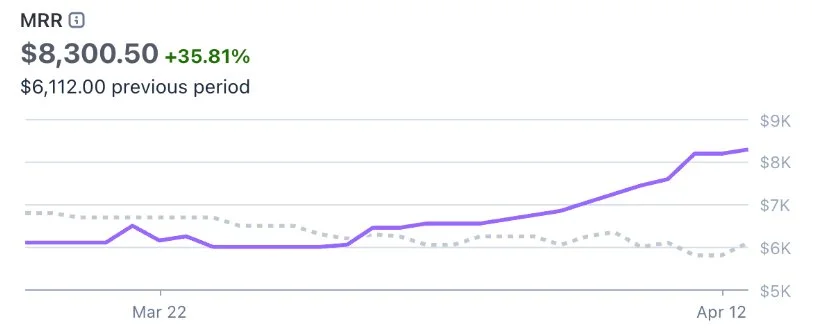
Today Replymer does $8.3K MRR. Same category. Different product. And almost every meaningful design decision I made the second time around is the opposite of what I did the first time.
This is a story about what you only learn after you build, sell, and rebuild the same product.
Why I built ReplyGuy in the first place
ReplyGuy wasn't the original idea. My actual product was a mention tracking tool - you enter keywords, we find conversations mentioning them. Useful, but crowded market.
Then a few users started asking the same thing: "This is great, but what if you could also write a reply for me? I see the mention, but I don't have time to respond to each one."
That was the "aha" moment. The real pain wasn't finding the conversations - it was having the time and energy to show up in them every day.
So I built an AI layer on top: the tool finds the mention, generates a contextual reply, you approve it, it gets posted. Full automation. This was late 2023, when AI writing was just starting to feel good enough for real use cases, and the idea of "AI agent that participates in Reddit threads for you" was genuinely novel.
It worked. Within months I had real paying customers. Within a year I had around 100 active subscriptions doing $6K MRR.
Why I sold
A few reasons converged at the same time.
I had a co-founder, and we were splitting revenue. The product was growing but not exploding, and we both felt it was consuming more energy than it was giving back.
More importantly, the operational problems were getting worse, not better. Reddit kept banning accounts. Our automation kept breaking. AI coding tools were still early and bad at the time - I was writing infrastructure code by hand, debugging edge cases manually, fighting platform anti-spam measures with duct tape.
Every week brought a new fire. New subreddit ban. New Reddit API change. New account compromised. New edge case in the AI-generated reply that made it look obviously fake.
I remember the exact feeling when we decided to sell: relief. Not excitement about the exit. Relief that someone else would deal with the daily operational chaos.
We found a buyer, closed the deal, and I walked away. Non-compete clause: 12 months. No building anything in the same category until October 2025.
The year I spent watching from the outside
For 12 months I couldn't build a reply tool, but I could watch the market. And I watched carefully.
Here's what I saw:
Every competitor in the space was racing in the same direction. More automation. More volume. Faster. Cheaper. AI-everything. The pitch everywhere was "our AI writes hundreds of replies per day, fully hands-off, zero work for you."
And I watched the results. Published replies that sounded obviously like AI. Accounts getting mass-banned. Reddit communities getting more hostile to anything that smelled automated. Customers churning after 2-3 months when they realized the replies weren't actually driving conversions - just volume.
The entire industry was optimizing for the wrong metric. Everyone was selling "replies per month" as if that was the value. But the actual value was something else: authentic presence in the right conversation at the right time. And you can't get that from pure automation.
Meanwhile, the AI itself was getting better, fast. By mid-2025, GPT-4 and Claude could write genuinely good Reddit comments if you prompted them well. The AI part - the thing that was hard in 2023 - had become the commodity part.
I was watching, taking notes, and slowly building a conviction: the next version of this product shouldn't double down on automation. It should do almost the opposite.
The three decisions I made differently
When my non-compete expired, I started Replymer from scratch. Not a refactor. Not a fork. A completely new product with completely new assumptions.
Here are the three decisions that matter.
Decision 1: Human writers, not AI generation
ReplyGuy generated replies with AI. The customer approved (sometimes) and we posted them. This was the default industry approach in 2023 and it's still the default today.
Replymer uses real human writers. Every single reply published through Replymer is written by a person on my team. The AI helps with finding opportunities and drafting starting points, but the actual text that goes on Reddit comes from a human who reviews the context, understands the product, and writes something that adds real value to the conversation.
Why this matters:
- Reddit communities can smell AI. In 2023 this was a future problem. In 2026 it's the present problem. AI-generated replies get removed, downvoted, or just ignored at much higher rates than human-written ones.
- Brand voice is impossible to fully automate. Every SaaS has a tone, a vocabulary, a way of talking about itself. AI can approximate it. Humans can actually match it.
- Context-awareness is a human skill. Reading a Reddit thread and understanding what the actual question is - not just the keywords - requires judgment that AI still doesn't reliably have.
This decision was counterintuitive from a business perspective. Human writers are more expensive, slower, and harder to scale than AI. The margins are worse. It's objectively the "wrong" answer if you're optimizing for standard SaaS metrics.
But it's the right answer if you're optimizing for the thing customers actually pay for: replies that work.
Decision 2: Quality over volume, even in pricing
ReplyGuy pricing was structured around volume: more replies per month for more money. Standard SaaS approach.
Replymer pricing is intentionally constrained. The Starter plan is $99/mo for 30 replies. Not 300. Thirty. Growth is $199/mo for 100 replies. Scale is $399/mo for 300 replies.
Every competitor in the space offers 5-10x more volume at similar price points. I get asked constantly why my numbers are "so low."
The answer is simple: because 30 high-quality, human-written, contextually-perfect replies do more for your business than 300 mediocre AI-generated ones. I've seen both sides of this experiment. The data is clear.
By constraining volume, I force every reply to matter. I force my team to only engage with conversations where the product genuinely fits. And I force customers to think of Replymer as a precision tool, not a broadcast tool.
This also aligns incentives. If I sold unlimited volume, my team would be pressured to post anywhere to hit numbers, and quality would collapse. With constrained volume, everyone on the team is measured on whether each reply actually helps.
Decision 3: Built for founders who've been burned
ReplyGuy's ideal customer was: "anyone who wants more Reddit presence." Broad ICP, easy to market, hard to keep happy.
Replymer's ideal customer is much narrower: a SaaS founder who has already tried Reddit marketing, gotten burned by either spam or low-quality automation, and now wants the thing to actually work without babysitting it.
These people are skeptical when they arrive. They've seen bad AI replies. They've been banned from subreddits. They've hired freelancers who disappeared. Their bar is high and they're not easily impressed.
So I built Replymer specifically for them:
- The homepage compares "growing with Replymer" vs "growing on your own" in honest detail - because this customer has already tried "on your own" and knows the pain
- Every feature is framed around trust: human review, real accounts with posting history, measurable ROI metrics, quality over quantity
- The SEO Replies feature exists specifically because technical founders understand that Reddit threads rank in Google and feed into ChatGPT recommendations - this is a nerdy feature for nerdy customers
- I explicitly position against the rest of the industry: while everyone else sells "more, faster, cheaper," Replymer sells "real humans, real quality, real results"
This is a smaller market than "everyone on Reddit." But it's a market that converts, stays, and refers other founders. Those 100 active subscriptions of ReplyGuy had high churn. Replymer's subscriptions stick.
What I learned about rebuilding a product you already built once
Most founders never get the chance to build the same product twice. You build, you succeed or fail, you move on. Even if you wanted to rebuild, the world has moved on by the time you're free to try again.
I got the chance, and here's what surprised me:
The second time is not about fixing mistakes. It's about rejecting the original premise. ReplyGuy's core premise was "automate Reddit replies with AI." Replymer rejects that premise entirely. It's not a better version of the same idea - it's a different idea that happens to address the same customer problem.
The obvious improvements are the wrong improvements. When I sold ReplyGuy, my list of "things I'd fix" was technical: better infrastructure, fewer bans, faster AI, smoother onboarding. If I'd just built ReplyGuy 2.0 with those fixes, I would have built a slightly better version of a flawed product. Replymer isn't ReplyGuy with better infrastructure. It's a completely different answer to the same question.
Time outside the product is more valuable than time inside it. Those 12 months of non-compete felt painful - I couldn't touch the thing I knew best. But watching the market from the outside, without being in the daily fires, gave me clarity that I never had while running ReplyGuy. If I'd started Replymer immediately after the sale, I'd have made the same mistakes.
Customers don't care about your journey. They care about results. I could have milked the ReplyGuy story hard - "founder who sold, now building v2." Some founders do this. It doesn't actually convert. What converts is showing up with a product that works better than the alternatives, and letting the work speak. The journey is context, not a feature.
Where Replymer is now
$8.3K MRR, growing steadily. About 45 active subscriptions across Starter, Growth, and Scale. 25,000+ replies published across 1,099 products. Three people on the writing team. Zero AI-generated reply copy being posted.
I'm not trying to compete with the automation-first tools in the space. They have their market, and some of them will do fine. I'm building for the other market - the one that wants the thing to actually work.
If you've been burned by Reddit marketing before, or you're a SaaS founder who wants to show up in Reddit and X conversations without turning into a full-time community manager, come check out Replymer. First replies go live within 24 hours of signup.
And if you're curious about the ReplyGuy → Replymer journey in more detail, or you're building something in this space yourself and want to talk shop, my DMs on X are open @AlexBelogubov.
P.S. If this article was useful to you, a repost would mean a lot. Articles like this one are pretty much my entire distribution strategy as a solo founder, and every share helps.