
This is the lifetime revenue (combined over the past 5 years) across our portfolio of writing businesses:
This doesn’t include Typeshare or Ghostbase, two SaaS businesses my business partner @dickiebush and I are co-founders of with another founder (h/t @samjshore ).

Now, let’s get to the good stuff…
10 Lessons Selling $15M of Digital Products
We have learned a LOT about selling digital products (aka “information”) online over these past few years.
So, let me bring you into the trenches.
Lesson #1: People drastically underestimate how much work all the above takes.
Something Dickie and I have said to each other often is: “If we knew how much work this was going to take, back at the beginning of the journey, would we do it again?”
Over the past ~5 years:
- I have written and re-written our entire Ship 30 curriculum 10+ times.
- I wrote all our marketing sequences, our FOMO sequences, our abandoned cart emails, our upsell emails.
- I wrote an entire upsell curriculum, called Write the Ship, that we used to sell as an “Advanced” version of Ship 30 in Year 2 for alumni (that we ended up throwing away a few months later).
- Then I wrote 5 other entire curriculums to add to a membership program we sold on the back-end of Ship 30 called The Captain’s Table.
- I wrote our weekly newsletter for the first 2 years before we ended up hiring our first writer. 52 issues per year, 2+ years, so easily over 100 newsletters.
- I wrote our Start Writing Online educational email course, and our Premium Ghostwriting Blueprint EEC, and our Start Writing With AI EEC.
- I wrote thousands of tweets and Twitter threads to drive traffic.
- I wrote the entire Premium Ghostwriting Academy curriculum (100,000+ words). Then, a year later, I re-wrote the entire thing because hundreds of students had gone through it and we knew how to make it better. Another 100,000+ words.
- I wrote another entire free curriculum on Packaging & Pricing to add to PGA, just because we knew it would be helpful for people.
- At the same time, I wrote and published The Art & Business of Ghostwriting.
- I wrote dozens and dozens of long-form ChatGPT prompts, both for Ship 30 & PGA.
- When we decided to turn Ship 30 async, I re-wrote the entire curriculum AGAIN, breaking it apart into 30 days and making it even better than it already was.
- I wrote hundreds of viral templates to add to our Typeshare library.
- Every Black Friday, in a sprint (usually 2-3 weeks), not only did I write an entire new product we could sell, and an upsell order bump product, but I also wrote all the marketing sequences and upsell sequences.
- I wrote and self-published my first fiction book, *The Monster Deck,* combining everything I loved in my childhood (Pokémon, Yu-Gi-Oh, and World of Warcraft).
- I built and launched my own Shopify storefront to sell my self-published books directly to readers after my Amazon account got banned out of the blue.
And this doesn’t even cover all the other side projects I have going on.
Napkin math, that has to be close to 100 million words (if not WAY more).
Any creator who says, “I make $9 million dollars per month only working 30 minutes per day” is lying for clickbait—and it drives me nuts, because it trains the next generation of entrepreneurs to think this sort of stuff is “easy” when it’s not.
It takes serious work.
Lesson #2: There’s no such thing as “passive income.”
It’s wild that people’s perception of the digital product world is that it’s an “easy way to make passive income.”
This couldn’t be further from the truth.
Like most things in life, but especially when it comes to digital products, the moment you start to ramp down “effort,” revenue goes down with it. This is a big pro/con of using organic traffic to build a business, for example.
(And to-date, 95% of our revenue has been driven through organic content. We’ve spent less than 5% of our revenue & time on experimenting with ads.)
With organic content, the pro is that you effectively have $0 CAC (customer acquisition cost).
Except, not really.
Yes it’s $0 on paper, but it’s very expensive from a time investment perspective. It costs hours.
And as soon as you ramp that time down, revenue tends to go down with it.
Now, the counter-argument most people make here is “that’s why it’s better to run ads.” Except, it’s a different version of the same problem. Ad algorithms are as demanding, if not more demanding than the organic content algorithms. And the moment you stop feeding the ad machine new creative, it stops working as well (or stops working altogether).
Ads also have a much more expensive ignorance tax attached to them. You have to spend a lot of money to learn how to do ads well (whereas organic content just costs you time).
So, either way, if you want your business to keep generating cash, you need to keep deploying effort.
There’s nothing “passive” about it.
Lesson #3: Not all digital products are created equal.
In the beginning, it’s easy to think that all digital products are the same:
- Selling an eBook is the same as selling a course
- Selling a $99 course is the same as selling a $999 course
- Selling a course is the same as selling a monthly membership
- Selling a monthly membership is the same as selling a paid newsletter.
- Etc.
It took us a while to learn (the hard way) that this is very wrong.
Not all digital products are created equal.
Each vehicle has a different business model, and each business model has different pros and cons.
For example, the way a customer values an eBook is completely different than the way they value an online course. And the way they value an online course is completely different than the way they evaluate an ongoing monthly membership.
And because of the differences in the way they perceive these different vehicles and business models, they also have different thresholds for what they would be willing to pay.
I’m going to expand on this point over the next few lessons:
Lesson #4: There are only 3 pricing tiers for selling an online course.
The way most creators choose a price for their digital product (especially online courses) is they basically stare out the window and wait for a number to land in their head.
In reality, the price of your online course has a huge impact on the way the customer makes their purchasing decision:
- Tier 1 - $350 or less: Any online course in this price range is considered an “impulse buy.” Most people (excluding countries where there are large currency discrepancies, which I understand) don’t “think” much about this sort of purchase. It’s like buying a blender on Amazon. And while they still have expectations to get their money’s worth, they aren’t expecting much more than helpful text & video modules—and the videos could be Loom videos. As long as the information provided helps them solve the problem or achieve the goal promised, they’re happy.
- Tier 2 - $350 to $1,000: Right around $350 and above is where the purchasing decision changes. In this price range, customers are expecting a little “more.” We got around this with Ship 30 for 30 because it wasn’t a passive online course, it was a cohort-based “experience.” (There’s a great book called The Experience Economy that talks about why customers pay more for experiences than they do products.) But even still, we found there was a cap—and it was right around $1,000. The highest price point we got Ship 30 to was $899, and right around there we noticed a steep drop-off in terms of new customers being willing to make the investment.
- Tier 3 - $3,000 to $10,000: The last tier is $3,000 and above. Contrary to what most people might think, there actually isn’t that big of a pricing decision between $1,000 or $2,000. It’s sort of this weird dead-zone where you’re “too expensive” for Tier 2, but you aren’t providing enough value to warrant being considered in Tier 3. In this price range, you aren’t selling a product. A passive online course with text and video modules won’t do. You have to become a hands-on training program, provide coaching, live sessions, accountability, community, etc. And maybe more importantly, the goal and value of your program has to in some way be tied (either directly or implied) to acquiring skills that will have an impact on the person’s career trajectory & earning potential. Otherwise, it’s too hard for the customer to rationalize making this sort of investment in themselves.
These 3 pricing tiers are way more ingrained in the broader education category than people realize—and if you aren’t aware of them, you’re either going to accidentally price out your target customer (depending on what your offer is) or you’re going to leave a ton of money on the table.
For example, if you have an async text & video course and you sell it for $49, you’re leaving a ton of money on the table.
Why?
Because it doesn't matter if this product is $49 or $149 or even $249. It’s actually all the same “tier” of purchasing decision. Conversely, if you try to sell an async text & video course for $800 and are confused as to why nobody is buying it, well, that’s because you’re in Tier 2, where customers are actually expecting something more—like an experience.
If you’ve never sold digital products before, it’s very hard to understand what I’m saying here and believe that a $49 product and a $149 product are the same purchasing decision.
But it is.
And that’s why I’m giving you the $15M lessons :)
Lesson #5: Books and eBooks are one of the worst business models for selling information.
As an author and someone who cares deeply about the craft of writing books, this is a painful one to talk about—but it’s the truth.
Books are one of the worst vehicles for monetizing information.
For a few reasons:
- “Books” as a vehicle are price-capped. Simply calling it a “book” or it being a “book” puts it in a pre-defined category anchored to a specific price range. Every person on planet earth knows a book should be between $10 and $30. If it’s less than $10, it’s on sale. And if it’s more than $30, it’s some ding-dong hardcover version (but even then, there’s a ceiling on how much someone is willing to pay… $40? $50?).
- Books can’t be price-anchored to an outcome. You can price anchor courses, webinars & live masterclasses, training programs, even paid newsletters to reader/customer outcomes because these are newer vehicles (whereas “books” have been around since… well… forever). Nobody would pay $200 for a book, but people pay $200 for yearly access to a paid newsletter without even thinking about it. And the reason they’re willing to do that is because a) it’s a different “vehicle,” and b) because most digital products that sell at a premium do a good job of price anchoring to an outcome. The reader isn’t buying “the information.” The reader is buying what the information will help them achieve or unlock in their life (and the value of that outcome).
- Books have no recurring revenue. Nobody buys a book more than once—and if they do, it’s either because a) they lost it (accidental second purchase) or b) they are gifting it to someone else. But even gifting isn’t “recurring,” it’s really just a word-of-mouth-inspired sale. Whereas if you took the exact same content & information in your book but made broke it into a bunch of pieces and published it as a paid newsletter, for example, you could a) price anchor to an outcome, b) charge more, and c) actually unlock recurring revenue (readers would subscribe for months/years to maintain access and/or keep reading more on the subject!).
I’ve written 11 non-fiction books at this point.
And I’ve learned that books are really only good for “Interesting” information (think Malcolm Gladwell, author of The Tipping Point, or Ryan Holiday, author of The Obstacle Is The Way) or “Entertaining” information (think Mark Manson, author of The Subtle Art of Not Giving A Fck*, or Jen Sincero, author of You Are A Badass).
But any specialized “How To” actionable information shouldn’t be put in a book.
I mean, you can—my book *Writer Career Paths: 9 Ways To Make $1,000,000 With Words* falls in this category.
But it’s the worst way to monetize the value of your knowledge.
You can easily make 10x more money by taking the exact same information and just choosing to “publish” it in a course or paid newsletter.
Lesson #6: If your digital product isn’t selling, there are usually 2 reasons why.
What happens if you’ve built a digital product and picked the right “pricing tier” but it’s still not selling (or selling as well as you’d like)?
There’s usually 2 reasons why:
- The first reason is that the digital product isn’t price-anchored to the value of an outcome (or a “valuable” enough outcome). A tell-tale sign this is the case is if the positioning of the digital product is to “learn.” The truth is, nobody wants to learn (just like how nobody wants to go to the gym). What people really want and care about is the outcome they can expect as a result of learning (just like how people want 6-pack abs in time for summer). Other signs include the product emphasizing features (not benefits) or the creator talking at length about “how much effort they put into making this product.” Again, nobody cares. They only care about the outcome and whether or not you can help them solve it.
- The second reason is that you aren’t hard-selling customers on your email list. A lot of creators are afraid to pitch customers on their email list more than one or two times because they think they are going to come off as “sales-y”—or worse, thousands of people will unsubscribe. First of all, it’s worth recognizing that none of this is “true.” It’s all a self-inflicted faulty belief, almost always rooted in some fear of rejection or underlying Imposter Syndrome. Second, if you are a creator with a digital product business, the number of people you “don’t bother” who sit idly on your email list is meaningless. Saying you have 100,000 email subscribers, who you never pitch and never ascend to being customers, is a vanity metric.
Now the argument here is: “Yea but the bigger my email list, the more I can charge for ads!”
OK… first of all, if you sell digital products, you should be promoting your own products, not your Athletic Greens affiliate code.
Second, even if you run ads, most good ad buyers want to see CTR and performance, so you’re still pitching customers—just on someone else’s product instead of your own.
And third, building an email list and running ads is a completely different business model, and not really what it means to sell “digital products.”
So if your digital product/online course isn’t selling, it is almost always a price anchoring problem, or a hard-selling problem where you really give potential customers a reason to pull out their credit card.
For what it’s worth, after running 20+ cohorts of Ship 30 for 30, we analyzed how many emails (on average) it took before someone finally decided to buy.
It wasn’t 1.
And it wasn’t 2.
It was nearly 20 emails.
Do with that information what you will.
This section contains content that couldn't be loaded. View on X
Lesson #7: Monthly memberships are the next most inefficient vehicle for monetizing knowledge.
“Everyone wants recurring revenue until they realize they’re signing themselves up for recurring work.” (Credit to my co-founder Dickie for putting this so eloquently.)
We have seen a trend of creators who run cohort-based businesses decide to move to an ongoing membership model.
The logic here is usually:
- A monthly membership is more affordable than a one-off online course purchase. And more affordable for the customer means “more customers.”
- Monthly memberships provide predictable, recurring revenue. Which sounds nice if you’ve been running a cohort-based course with lumpy revenue cycles.
- Monthly memberships are more “passive.” You can create it once and just sort of let it run on autopilot.
Unfortunately, all of these are wrong.
We ran a monthly membership for about 2 years on the back-end of Ship 30 for 30, called The Captain’s Table.
In it, we had a number of “advanced” async courses—like how to start a newsletter, and how to even build your own online course. Things we knew “most” people in Ship 30 would want to build next. We also had a private Circle community, and held 60-minute weekly live sessions for all Captain’s Table members, with us.
But we ran into the following problems:
- The moment someone joins a “membership” with instant access to lots of different education products, the value of all those products immediate goes to $0. Creators think by having a membership program that people will pay for “ongoing access” to this content. In reality, the moment people get access to it, they don’t value it anymore.
- Recurring revenue means recurring work. Let me be clear, there is absolutely nothing passive about it. Because of the first problem (value going to $0 upon joining), the way you retain value is by adding “more” new content/information each month. That’s usually the strategy for keeping customers engaged. So, what did you just do? You basically traded your one-off business model (where you sell 1 course) for a recurring business model where you sell a “mini-course” once per month for a fraction of the price.
- Recurring revenue doesn’t “recur” forever. There’s this weird belief creators (and entrepreneurs) have that once someone signs up for a monthly subscription service, that revenue will just be there… indefinitely. And obviously, that’s not true. In most cases, if you do the math on the cost of joining the membership program and look at the average churn rate, the LTV (lifetime value) of your customers ends up being LESS than if you had just sold them on a higher-priced one-off product. For example: a $50/mo membership site with an average churn of 3 months = $150. So if you used to sell a $350 async course, or an $800 cohort-based course, and you just swapped your business model for a membership site, you just lost a ton of money because you picked the wrong vehicle.
Now, does that mean membership programs can’t work?
Of course not.
We’ve only recently built the skills (and the team) to create this new vertical in our portfolio. AI Writing Skool is the leading educational community for writers, creators, and builders who want to stay on the cutting-edge of AI.
As an AI Writing Skool member, you instantly unlock:
- Instant access to our exclusive AI model, "AI Cole" (trained on all of our content & programs)
- Monday Hot Seat live call with me
- Weekly AI & Tech Clinic with my business partner, Mitch Harris
- Monthly writing templates, AI prompts, and Claude .Skills
- 50%-off all LIVE 2-week bootcamps
Even with a rapidly growing community, I recommend doing some napkin math before jumping into building a membership program:
- What’s your average customer LTV right now?
- How much do you want to charge for a monthly membership?
- Realistically, what do you think the average churn amount will be? (Or what have you already learned it is?)
- If that price x average churn = less than your current customer LTV, then don’t do it.
You’ll just be doing more work to make less money.
Lesson #8: The broader your front-end product, the harder it will be to build a high-converting backend product.
This is something you don’t have to worry too much about if you’re brand new to launching digital products—because Step 1 is just building “something” people love.
But we learned this lesson running Ship 30, and it completely changed how we thought about building our Premium Ghostwriting Academy.
Ship 30 is a very broad front-end product. It’s for people who want to “start” writing online. As a result, we get a LOT of different archetypes who take the course:
- People who have never written a single thing on the Internet before, ever.
- People who have been writing for a long time, but are new to “digital writing.”
- Teenagers interested in The Creator Economy.
- Retired folks who have “always wanted to write.”
- The list goes on and on—spanning every age range, on every continent, exploring just about every writing topic you could possibly imagine (including but not limited to: knitting, biotechnology, and feminist scrapbooking)
The pro here is that Ship 30 is both extremely specific (only for people who want to “start” writing online) and extremely broad at the same time.
Over 10,000 people have gone through Ship 30 at this point. But that pro is also the con—and because so many “different” types of people take Ship 30, it’s nearly impossible to create an upsell or back-end offer that speaks directly to all of them.
When we started building our Premium Ghostwriting Academy, we decided to do the opposite.
Instead of trying to build something “for every type of writer,” we said:
- This is only for people who want to get into the world of ghostwriting.
- And not all ghostwriting, but 1 specific type of ghostwriting: creating Educational Email Courses.
In the beginning, this felt painfully specific. How could it not? Conventional wisdom says to create offers that bring in EVERYONE! But now, after running PGA for a year and a half, we can see how much easier it is to build offers on the back-end of PGA.
Because when someone completes PGA and lands their first, then second, then third ghostwriting client… what do they need help with next? They need help managing those clients, upselling them, and building themselves into a 1-Person Business. (Which we help them do in our bridge program, Liftoff.)
Since our front-end offer is so specific, the back-end offers practically create themselves—because we know EXACTLY who we are helping, and EXACTLY what they need help with next.
Lesson #9: The best digital education products are 50% education, 50% belief-breaking.
For the first ~2 years building digital products, we mostly thought about them as vehicles for “explaining” things and passing along knowledge.
Very “How To” oriented.
But after a while, we started to realize “the information” was only 50% of the learning process. And the real bottleneck holding a student back usually wasn’t the information itself, but their own internal objections:
- “Sure, this might have worked for you—but it won’t work for me.”
- “That works for your industry/niche, but it won’t work for my niche.”
- “This works for business/marketing content, not for what I want to write about.”
- “I’ve tried this once before and it didn’t work, so I don’t think it’ll be any different this time.”
- Etc.
Overcoming customer objections isn’t just part of front-end marketing content.
You have to continue helping them overcome their internal objections all throughout the product itself.
And you have to go multiple layers deep: presenting an idea, overcoming the objection, overcoming the objection beneath that, overcoming the objection beneath that, etc.
For example, in Ship 30 for 30, one of the frameworks we teach digital writers is how to write effective headlines.
In the V1 of our curriculum, we just said, “Here’s how you write a great headline”—not realizing that the information and framework of “not knowing how to write a great headline” wasn’t the real problem.
It took us a while to follow the logic line of our students and realize, when we presented this framework, the following would happen:
- Here’s how you write a great headline! Use these 5 pieces.
- “Ok but if I use those 5 pieces, then I’m writing clickbait.”
- Here’s why this ISN’T clickbait—and how you can keep your promise to the reader.
- “I don’t think readers in my industry would be willing to read this sort of content that makes all these big promises. They’re too smart.”
- Here’s why this framework works for every industry, and why every reader (regardless of education background) will want to click and read.
- “Well I’ve tried writing a headline like this before and it didn’t go viral, so I don’t think this approach works.”
- Here’s why you need to write and publish at least 30 pieces, with these types of headlines, to gather signal and really learn what works. You have to extend the time horizon.
- “OK, fine, but I want to wait until it’s perfect before I hit publish—because I don’t want to put something unfinished out into the world.”
- Here’s why you should hit publish on your rough drafts, and just get your ideas out into the world. You’ll learn more, faster.
- “OK but honestly I’m just afraid of looking stupid and being judged.”
If you follow the logic line long enough, you will learn that the hard skills of whatever you’re teaching or explaining aren’t the real bottleneck on the person’s growth.
99% of the time, the bottleneck is rooted in some sort of faulty belief or internal objection—and so if your education product doesn’t ALSO address these objections, the “How To” information isn’t going to land.
Now, the inverse is also true.
If your education product is 100% mindset content and 0% actionable “How To” content, you have the same problem just reversed.
You might be doing a great job of addressing objections, but once the student makes those mental shifts and is ready to take action… what do they do? Where’s the “How To” content?
My personal belief is that online courses (and the e-learning category at large) have such a bad reputation because most creators don’t realize they need both of these components.
So what happens is a creator will launch a course that is 100% “How To,” address 0 objections, and then wonder why hardly any students put their learnings into practice.
Or, a creator will launch a course that is 100% “mindset-oriented,” and give hardly any actionable “How To” content, and then students are left feeling like they attended a motivational seminar but didn’t actually “do anything.”
But the online courses & digital products people love, and are happy to pay a premium for, do both.
Lesson #10: There is a recipe for the “perfect” course module.
After writing & re-writing so many different course modules, I have learned there is a very specific “stack” of pieces you need to make a module bullet-proof.
As in, creating something that leaves almost 0 room for interpretation and/or lingering questions from students, which is the goal. You want someone to go through every single module and think:
- “I know exactly what to do.”
- “I know exactly what not to do.”
- “And I know exactly why I should do it this way instead of that way.”
Now, depending on what you’re explaining in your digital product, you might not always be able to get all of these pieces into every single module.
But it’s a good “stack” to aim for:
- Reasons Why (Benefits): At the beginning of each module, you want to start with some “thinking about thinking” and explain WHY you are taking the approach you are. It’s helpful for people to see the forest from the trees before you take them truffle hunting.
- Mistakes To Avoid (Problems): Next, you have to realize that no matter how well you explain WHY you are taking the approach you are, people are going to have objections. You say, “Here’s why,” and they say, “Yea, but…”. And so you should get ahead of those objections by saying, “And I’m sure you’re probably thinking…” + whatever their objection is, and then educating them further on why that is a mistake, why that leads to a different or less desirable outcome, etc.
- Steps How To (Action): Third, once you’ve explained WHY and addressed their first tranche of objections, you can get into the “How To.” This is the value the person likely signed up & paid for, and is the most important part of the module. But again, most people aren’t even aware of their own internal objections or faulty beliefs, so you need to sandwich the actionable content with this belief-breaking content. Some quick tips to make this section as valuable as possible: break things down into steps, not ideas; use screenshots and visuals as often as possible; add in realistic & relatable examples; etc.
- Commonly Asked Questions (Objections): Fourth, after you explain “How To” do something, the person is going to have a second tranche of objections—so you need to pause and address those too. What are all the questions you could imagine someone asking at this point? What are all the faulty beliefs they might be telling themselves, keeping them from putting all your “How To” information into practice?
- Walkthrough Example (Proof): Lastly, one of the best things you can do is actually add a section showing you DOING everything you just explained. Most online courses are text & video, and the video in each module is just the creator “explaining”—which is good and helpful. But what takes it over the top is if you end by adding a second video, actually SHOWING yourself doing what you just explained. Think of this as a way of overcoming the last objection someone might have: “OK, this all makes sense in theory, but I’m not really sure this works in practice.”
For example, we do this in our Premium Ghostwriting Academy in our sales module, where we train ghostwriters on how to find & pitch ghostwriting clients.
At the top of the module, I have a video “explaining.”
Then, at the end of the module, I have a video of me actually doing the thing I just explained: showing myself doing a mock pitch to a potential client.
And then I even went one step further and recorded another video, watching my mock pitch and pausing it intermittently, explaining all the little things I did, and why.
This is, by far, the most popular module in PGA because it goes so many layers deep—and now that I’ve seen the impact of this full “stack,” I will never create digital education products the same way again.
Final Thoughts
One last thing I’d like to share:
When creating digital information products, it’s impossible to make all customers happy, all the time.
- If you make the content too “prescriptive,” customers will say they want more optionality & freedom.
- But if you fill the content with too many different options (“You can do this OR this!”), customers will say they’re frustrated because they don’t know which path to choose—and say they just want a prescription.
- And if you only give 1 example, customers will say they want more examples.
- But if you give too many examples, customers will say they want fewer examples so they don’t feel overwhelmed.
- Etc.
After having over 10,000 people go through Ship 30 for 30, over 2,000 people go through our Premium Ghostwriting Academy, and over 1,500 paying subscribers on our Write With AI newsletter, I can tell you first-hand that this is unavoidable.
It’s just part of the game.
And instead of getting frustrated, the reframe I would encourage (and remind myself of often) is that all of these are opportunities to keep helping your target customer in new and different ways:
- If they want something smaller, more digestible, that could be a smaller downsell product.
- If they want something longer, more in-depth, more “hands-on,” that could be a higher-ticket program (an upsell).
- If they want the content in a different medium, that could be a different product or platform (like we’ve done with Typeshare).
- And if they want the same content at a different cadence, that could be a different business model—like moving from an async course to a paid newsletter or evergreen Skool community/membership.
The point is, when a customer says they want something different, the conclusion shouldn’t be: “They think my product sucks.”
The conclusion should be: “That’s a great idea! I can create something else that solves that specific problem, and monetize my knowledge again!”
I hope these takeaways help you on your own digital product journey.
And if you’re ready to start and scale an education business to $100,000 per year…
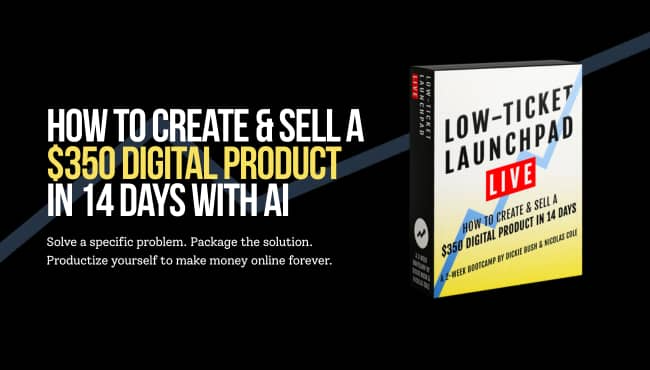
On April 27th, we’re kicking off Low-Ticket Launchpad LIVE: How To Create & Sell A $350 Digital Product.
This is our Internal Playbook for how we build, launch, and sell our digital products.
It’s everything we’ve learned over the last 5 years about making 6 and 7-figure incomes from digital products all in one place—and for the first time, we're walking you through it live.
We cover everything you need to:
- Choose a profitable idea and build a sellable digital product—even if you think your niche is too small or no one would pay you $350 for what you know.
- Package and price your product into an offer so good that people will be compelled to buy—these are the pricing, naming, and offer stacking frameworks we’ve used to generate over $15,000,000 in digital product sales.
- Build the backend tech engine to keep your digital product humming—with recommendations for product hosting, payment processing, and more (perfect for everyone—no matter your level of experience).
- Market your digital product—with all our “secret strategies” for attracting tens of thousands of customers organically, on X, LinkedIn, and YouTube.
- Sell your digital product—so you can convert traffic into customers and create a profitable revenue stream that pays you dividends for years into the future (think launch strategies, email sequences, and more).
In the live bootcamp, you'll move through the material at the same pace as everyone else, with homework between sessions and access to live Hot Seats where I will workshop student questions, product ideas, and landing pages in real time.
You get the playbook.
You have me holding you accountable.
And you'll have your first product up for sale by the end of week one.
Click here to save your spot and hop aboard.