I post every single day.
Articles, threads, tweets, crypto analysis, AI tool breakdowns, newsletters.
One person. No team. No content agency. No ghostwriter.
141K followers and the top posts on my account have hit 3.7 million impressions.
People ask me constantly how I do it without burning out or running dry.
The answer is not discipline. It is not a content calendar. It is not batching.
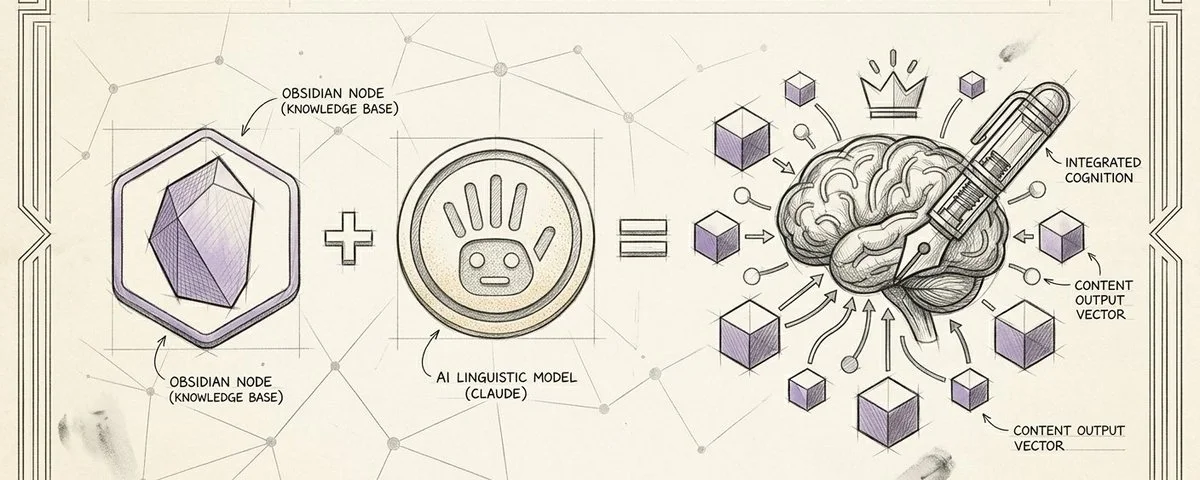
It is a system that captures everything, connects ideas automatically, and lets Claude write from my brain instead of from nothing.
Here is the exact setup.
Why Most Content Creators Hit a Wall
The problem is not output. The problem is input.
Most creators run out of things to say because they never built a real system for capturing what they already think.
They sit down to write and stare at a blank page. They scroll Twitter looking for inspiration. They copy what worked for someone else last week.
The content feels empty because it is. There is no real thinking behind it. Just reaction.
The people who create consistently at a high level are not more creative. They have more raw material to work from.
That is what Obsidian solves.
And when you connect Obsidian to Claude, something different happens entirely.
Phase One: Capture Everything
Obsidian is a local markdown note taking app. Every note is a plain text file on your own machine. No cloud lock in. No subscription dependency. Just files.
The first thing I built was a capture system with zero friction.
The rule is simple: if a thought is interesting enough to think, it is interesting enough to save.
I capture in four categories:
Observations — things I notice in the market, in AI, in how people behave online. Not analysis yet. Just the raw observation.
Reactions — my genuine response to something I read, watched, or experienced. Not a summary. My actual opinion.
Patterns — things I see repeating across different domains. BTC doing the same structure it did in 2020. An AI agent doing what quant funds did 30 years ago. These cross domain pattern matches become my best content.
Numbers — real data points. My post impressions. Engagement rates. Price levels. Token moves. Real numbers always beat vague claims.
Every note gets tagged immediately. Three tags maximum. If I need more than three tags to describe a note, the note is not specific enough.
Phase Two: The Daily Input Ritual
Every morning before I open Twitter I spend 20 minutes adding to the vault.
Not writing content. Just adding inputs.
I pull from four sources:
Crypto price action. What moved overnight. What held a level. What broke. I write the observation in plain language. BTC held $68K and bounced hard off EMA touch. TAO demand zone $190 to $240 absorbing sell pressure again. Short punchy observations. Not analysis yet.
AI news. One or two things that actually matter. Not the press releases. The real developments. What shipped. What broke. What someone actually built.
Something I read. A paragraph from a book, a research paper, a thread. Not summarized. The exact thing that hit me and why.
One personal observation. Something I noticed about my own performance, my audience, my numbers. These become my best posts because nobody else has this data.
Twenty minutes. Four categories. Done.
The vault gets richer every single day. And because everything is linked, pulling content ideas later takes about three minutes.
Phase Three: Connect (This Is Where the Magic Happens)
Raw notes are not content. Connected notes are content.
Obsidian has a graph view that shows every note as a node and every link as an edge. The more you link, the more you can see the shape of your own thinking.
I link notes manually when I create them. But I also run a weekly connection session where I ask Claude to find links I missed.
Weekly connection prompt:
"Here are 20 notes I added to my vault this week: [paste notes]
Find every non-obvious connection between these notes. I am not looking for obvious surface level links. I am looking for the same underlying principle appearing in two different domains. A pattern in crypto price behavior that mirrors a pattern in audience growth. A quant principle that applies to content creation. A trading rule that works as a life rule.
For each connection you find, give me one sentence that bridges the two ideas. That sentence is a potential tweet hook."
This is where my best content comes from.
The post about Jim Simons and prediction markets came from a connection between a quant principle note and a Polymarket observation note. Two things that had no obvious relationship until Claude found the bridge.
The Obsidian plus Claude Code post that hit 443K impressions came from connecting a note about second brains with a note about how Medallion Fund used a monolithic model.
The connections are always there. You just need a system to surface them.
Phase Four: The Content Brief
Before I write anything I create a content brief inside Obsidian.
Not an outline. A brief.
The difference is that an outline is a structure. A brief is a contract with yourself about what the content must deliver.
My brief has five fields:
The one thing. What is the single insight this piece is built around. If I cannot state it in one sentence it is not ready to write yet.
The proof. What real number, real result, or real example backs the one thing. No vague claims.
The reader transformation. What does the reader know or feel at the end that they did not know or feel at the start.
The hook. The exact first line or first two lines. Written before anything else.
The closer. The exact last line. Written before the middle.
Hook and closer first. Always. The middle fills itself.
Content brief generation prompt:
"I want to write a [tweet thread / article / newsletter] about [topic].
Here are the raw notes I am pulling from: [paste linked notes]
Help me complete this brief:
One thing: Proof: Reader transformation: Three possible hooks ranked by how hard they hit: Three possible closers ranked by urgency:
Do not write the content yet. Just the brief."
Phase Five: Create (Claude Writes FROM My Brain)
This is the part people do not understand.
Most people use Claude like a search engine. They ask it a question and take the answer.
I use Claude as an extension of my own thinking. The prompts I run are loaded with my voice, my data, my observations, my specific numbers. Claude is not generating content from nothing. It is shaping content from everything I already captured.
The output sounds like me because the input IS me.
Article generation prompt:
"You are writing in my exact voice. Here is how I write: Short punchy sentences. No paragraph longer than two lines. No dashes anywhere. No AI sounding language. Confident but not arrogant. Real numbers always beat vague claims. I give away real information. That is my brand.
Here is the content brief: [paste brief]
Here are the source notes to pull from: [paste linked notes]
Write the full article. Every section must add specific value. No filler. Open with a personal result or number. Include at least three copyable prompt blocks formatted as code fences. End with a bookmark CTA."
The first draft comes back strong because the brief is strong and the notes are real.
Then I edit for voice. I tighten. I cut anything that does not add information.
The whole process from blank vault to published article takes about 90 minutes for a 2000 word piece.
Without the system it used to take a full day and still feel incomplete.
The Compounding Effect Nobody Talks About
Here is what makes this different from just using Claude as a writing tool.
Every article I publish becomes a note in the vault.
Every tweet that performs well gets saved with its metrics.
Every insight I generate from a connection goes back into the system.
The vault gets smarter every week. And so do the outputs.
Six months from now my content will be better than it is today not because I got more creative. Because I have six more months of captured thinking, connected patterns, and real data feeding the system.
This is how one person creates at a level that feels like a team.
Not by working harder. By building something that compounds.
The people who keep starting from scratch every day will still be staring at blank pages in 2027.
The ones who build the vault now will be operating on a level those people will not be able to reach without years of catching up.
The Full Stack (Copy This Exactly)
Here is every component in order:
Obsidian — local vault, daily capture, four categories, three tags max per note, graph view on weekly review.
Claude — connection finder, brief generator, voice matched writer, pattern bridge identifier.
The daily ritual — 20 minutes of inputs before opening Twitter.
The weekly session — connection prompt run across the week's notes.
The brief — one thing, proof, transformation, hook, closer. Always written before the article.
The feedback loop — every published piece goes back into the vault with its performance data.
That is the full system.
Not complicated. Not expensive. One app and one AI model.
The edge is in the consistency of the ritual, not the complexity of the tools.
Bookmark this and build the vault this week.
Follow @cyrilXBT for daily breakdowns on Claude builds, AI tools, and real crypto analysis.